Repair or Replace Your Water Heater? How Arizona Homeowners Decide
Repair or replace your water heater: the signs that point each way, the 50 percent rule, and Arizona-specific factors like hard water and permits.

Your water heater stops working the same week a repair truck is already scheduled to be in your neighborhood, and suddenly you are being asked to choose between a repair that costs a few hundred dollars and a replacement that costs a few thousand. Most Arizona homeowners face this exact question with incomplete information, and the wrong answer wastes money either way: paying for a repair on a tank that is already finished, or paying for a whole new unit when a new thermocouple would have solved it. This guide walks through how to decide, what to look for, and what the numbers look like as national averages so you can make the call with confidence.
The short answer: repair the water heater when the problem is a single part (thermocouple, heating element, gas valve, thermostat), the tank is under about 8 to 10 years old, and the tank shell itself is not leaking. Replace it when the tank is rusted through or leaking from the shell, the unit is past 10 to 12 years old in Arizona conditions, or repairs would cost more than roughly half the price of a new unit.
What Is Actually Broken? The Two Different Kinds of Water Heater Failure
Every water heater problem falls into one of two buckets, and the bucket determines the answer. The first bucket is part failures: individual components that wear out and can be swapped without disturbing the tank. The second bucket is tank failures: damage to the steel shell or its lining that cannot be repaired, only replaced. Knowing which bucket you are in is the entire decision in most cases.
Part failures you can repair
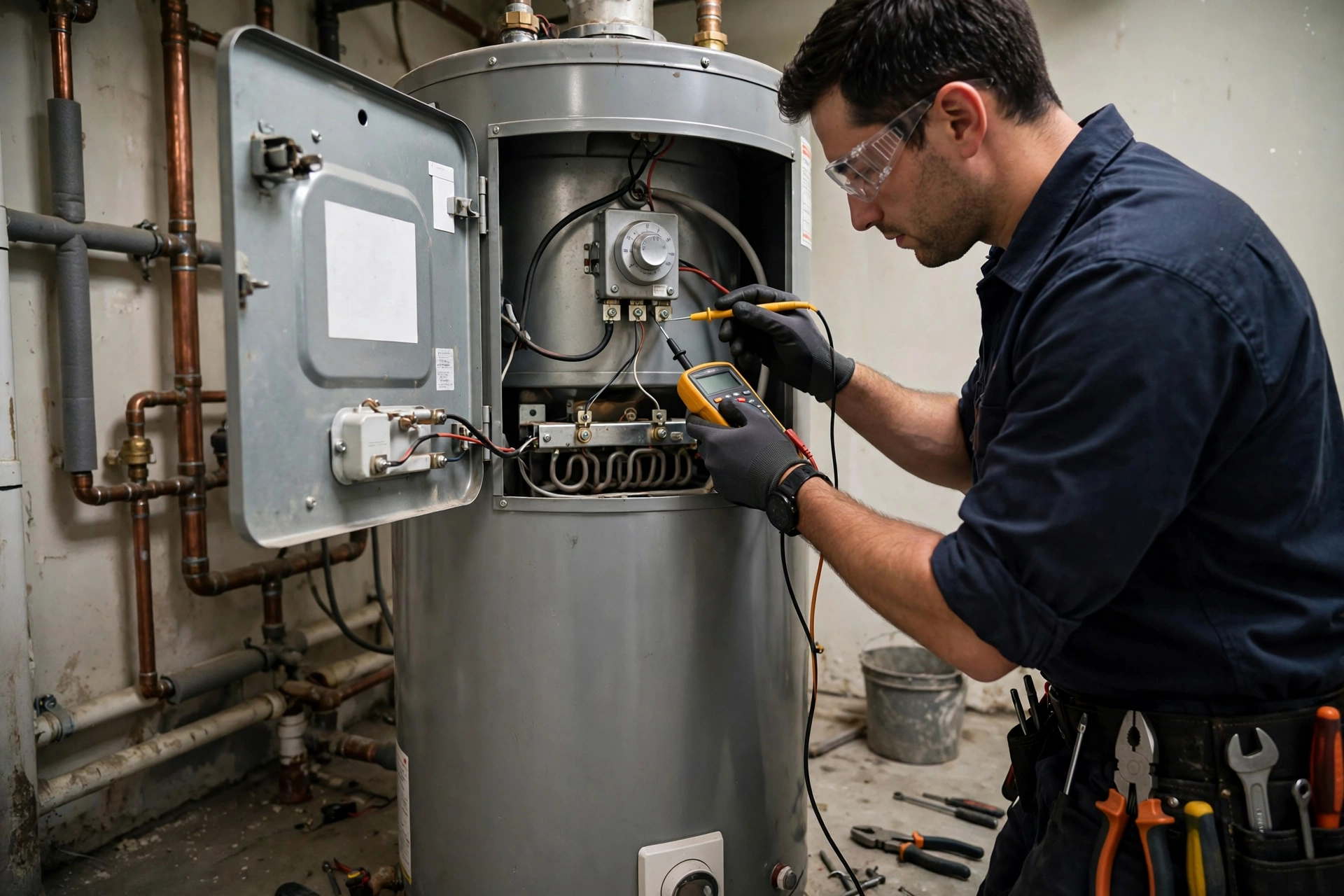
A surprising share of "my water heater died" calls turn out to be one failed component. On gas units, the most common culprits are the thermocouple (a small sensor that tells the gas valve the pilot is lit), the pilot assembly itself, and the gas control valve. On electric units, heating elements and thermostats fail regularly, and both are designed to be replaced from access panels on the side of the tank. Temperature and pressure (T&P) relief valves, drain valves, and anode rods are also consumable parts with finite lives.
These repairs share two traits: they leave the tank untouched, and they cost a fraction of replacement. A water heater repair visit that ends with a new heating element or thermocouple is a normal, routine outcome, not a stopgap. If the rest of the unit is sound, replacing the part returns the heater to full service.
Tank failures that mean replacement
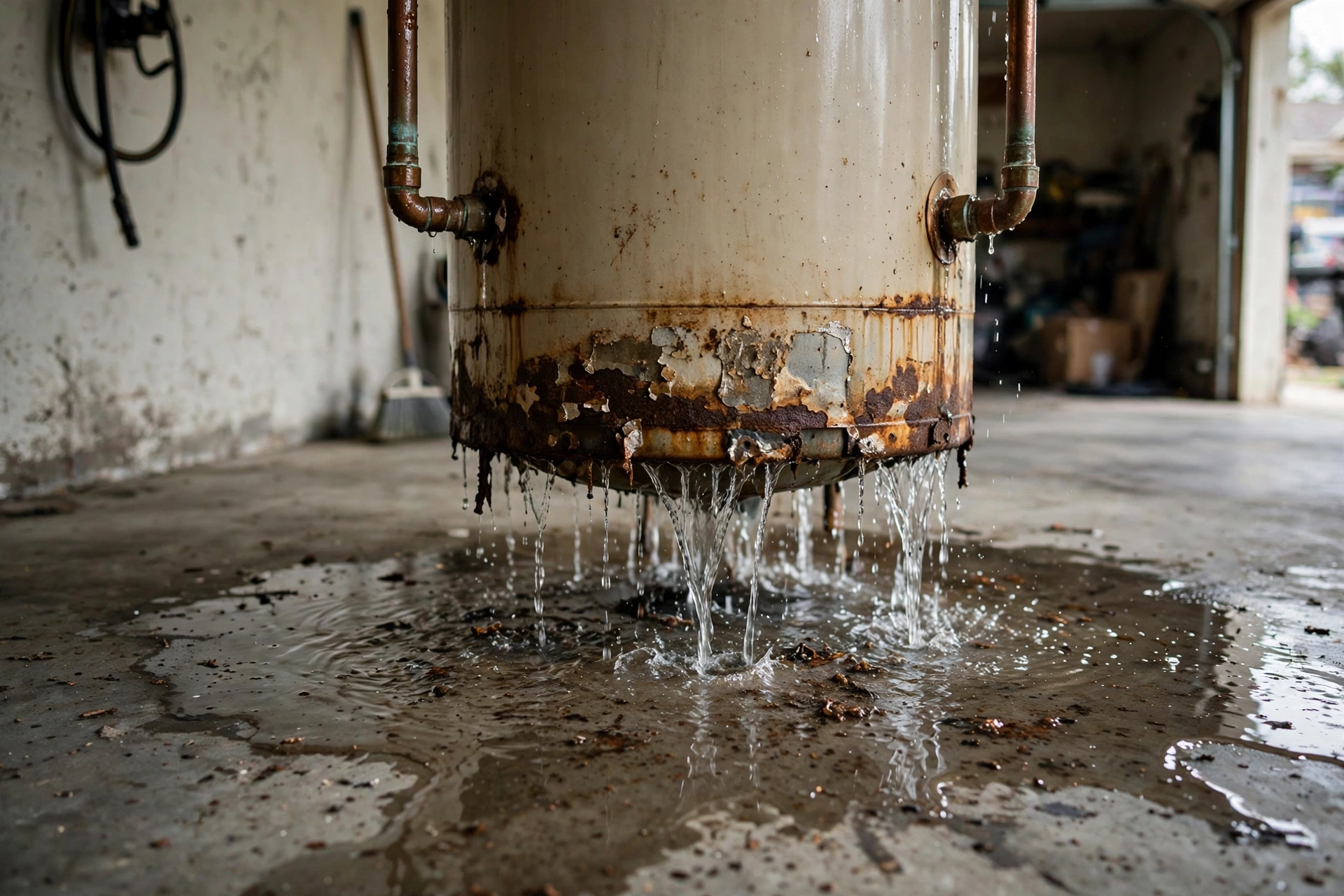
The steel tank is the part that cannot be fixed. Water heaters are glass-lined steel tanks with a sacrificial anode rod that corrodes first to protect the steel. Once the anode is gone and corrosion reaches the steel, the tank begins to rust from the inside out. The symptoms are unmistakable: rusty or discolored hot water, a metallic taste, dampness or puddles at the base of the tank, or visible corrosion and weeping around fittings on the tank shell itself.
Here is the hard line that every honest technician draws: a leak from the tank shell cannot be repaired. Patching, sealing, or welding a residential water heater tank is not a legitimate service, and any attempt at it is unsafe given that the tank operates under pressure. If water is coming from the tank itself rather than a fitting, valve, or pipe connection above it, the unit is done. Learn more about what a leaking water heater means and why the source of the leak matters.
The Age Question: How Long Water Heaters Last in Arizona
Nationally, a standard tank water heater lasts about 8 to 12 years, according to the U.S. Department of Energy. In Arizona, homeowners should plan on the shorter end of that range. Two Arizona-specific factors shorten tank life:
- Hard water. Much of the Phoenix metro and surrounding areas has very hard water, rich in calcium and magnesium. These minerals settle as sediment on the bottom of the tank, where they insulate the water from the burner or element, force the unit to work harder, and accelerate corrosion of the tank lining.
- Heat. Garages and utility closets in Arizona routinely sit at high temperatures for months. A water heater that is already hot on the outside and running constantly on the inside accumulates wear faster than the same unit in a mild climate.
Age is the best single predictor of whether a repair is worth it. A 4-year-old tank with a failed heating element is an obvious repair. An 11-year-old tank with the same failure deserves a harder look, because the next failure is likely to be the tank itself, and you do not want to pay for a repair this month and a replacement next quarter.
Real talk: Nobody can tell you exactly how much life is left in your specific tank, and any technician who claims certainty is guessing. What we can do is read the combination of age, visible condition, water quality, and maintenance history and give you an honest probability. Ask for that combination, not a guarantee.
The 50 Percent Rule and Other Cost Math
A useful rule of thumb used across the trades: if a repair costs more than about half the price of a new unit, replacement usually makes better financial sense, especially on an older tank. The logic is simple. A $900 repair on a 10-year-old tank buys you a fixed part inside a vessel that is near the end of its life. A new unit buys you a full fresh lifespan plus a new warranty period.
To apply the rule you need both numbers. Repair pricing is usually straightforward: a diagnostic visit plus the part. Replacement pricing varies more, because it includes the unit, installation labor, and whatever the specific installation requires (venting changes, gas line upgrades, pan and drain line, expansion tank, code updates, and permit fees where the city requires them).
What replacement typically costs (national averages)
The figures below are national industry averages, not quotes, and Arizona pricing can differ with local labor rates and code requirements. They are useful for the repair-versus-replace comparison, not as a budget.
- Standard tank replacement (gas or electric): national averages commonly fall in the low-to-mid thousands of dollars installed, depending on tank size, fuel type, and installation complexity.
- Tankless replacement: typically higher than a tank unit, often substantially so, because installation can require upgraded gas lines, new venting, and electrical work.
- Common repairs (thermocouple, element, thermostat, valve): generally in the low hundreds of dollars, parts and labor.
When you have both numbers in front of you, the decision often makes itself. A $250 repair on a 6-year-old tank is a clear repair. A $1,100 repair estimate on a 12-year-old tank with rusty water is a clear replacement. The gray zone is in the middle, and that is where age and tank condition tip the scales.
Repair It: The Checklist
Lean toward repair when most of these are true:
- The unit is under about 8 to 10 years old (check the serial number; the manufacture date is usually encoded in the first characters).
- The problem is a single failed part: thermocouple, pilot assembly, heating element, thermostat, gas valve, or T&P valve.
- The tank shell is dry, with no rust streaks, dampness, or corrosion at the base or seams.
- Hot water is clear and normal-tasting; no rust color or metallic smell.
- This is the first or second service call on the unit, not the fourth.
- The repair estimate is well under half the cost of replacement.
Common repair scenarios Arizona technicians see constantly include a water heater that has stopped working because of a failed thermocouple or tripped element, gas unit ignition problems, and electric unit element or thermostat failures. All are routine part swaps on a healthy tank.
Replace It: The Checklist
Lean toward replacement when any of these are true:
- Water is leaking from the tank shell itself (base, seams, or body), not from a fitting or valve above it.
- Hot water is consistently rusty or metallic-tasting, which signals internal tank corrosion.
- The unit is 10 to 12+ years old in Arizona conditions, especially if it has never been flushed or had its anode rod checked.
- Repairs would cost more than about half of replacement.
- You have already repaired it more than once in the last couple of years; repeated part failures on an old tank are the tank telling you it is finished.
- The tank is visibly corroded, bulging, or weeping at seams.
A replacement is also the right moment to reconsider the type of unit. If you are replacing anyway, the incremental cost of switching from tank to tankless (or sizing up a tank) is worth evaluating against your household's hot water habits. Read more about water heater replacement options before you decide.
Tank vs Tankless: The Replacement Fork in the Road
If you decide to replace, the next question is whether to stay with a conventional tank or switch to tankless. Neither is universally better; they suit different households.
Conventional tank
Tank units cost less upfront, are simpler to install, and any technician can service them. They keep 40 to 50 gallons hot around the clock, which means standby energy loss but also means hot water is instantly available and the technology is dead simple. For most Arizona households with predictable hot water use, a tank is the economical default.
Tankless
Tankless units heat water on demand, so they never run out and waste no standby energy. They last longer than tanks when maintained (often 20+ years for the heat exchanger) and take up far less space. The trade-offs are real, though: higher upfront and installation cost, potential need for gas line or venting upgrades, and in hard-water Arizona they demand regular descaling maintenance or the heat exchanger will scale up and fail early. A tankless unit in Arizona without a descaling plan is a short-lived tankless unit.
The Department of Energy notes that tankless units can be more energy efficient than storage tanks, with the biggest savings in homes that use less hot water per day. For high-use households, the efficiency gap narrows. Match the technology to your usage, not to the marketing.
Arizona-Specific Factors That Should Shape Your Decision
Hard water and sediment
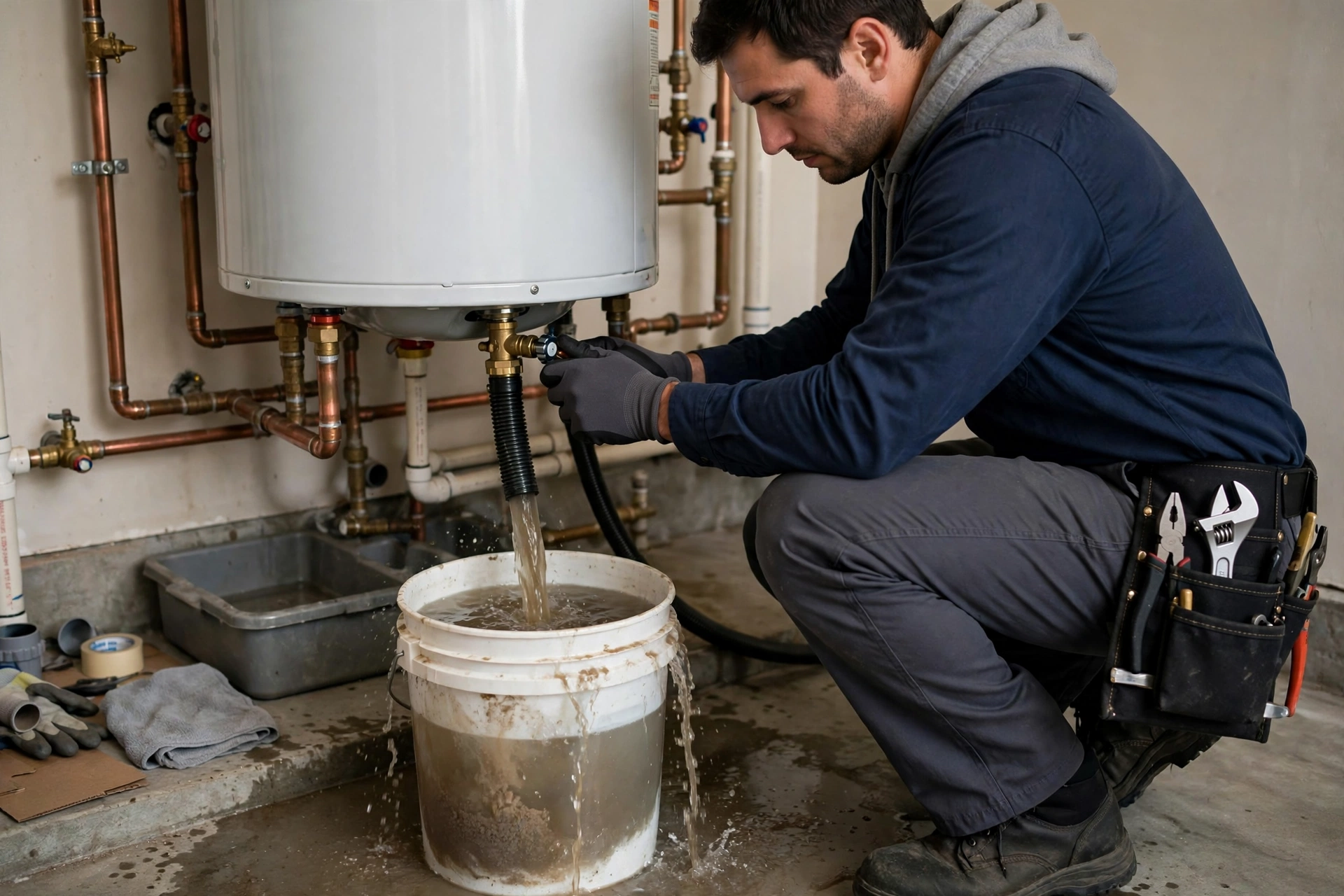
Sediment is the slow killer of Arizona water heaters. Minerals precipitate out of hard water and collect on the tank bottom, where they do three kinds of damage: they insulate the burner or element from the water (wasting energy), they create hot spots that stress the tank lining, and they cause the popping and rumbling noises many homeowners notice. If your unit makes noise during heating cycles, that is sediment talking.
Sediment matters for the repair decision because a heavily scaled tank is a tank whose lining has been under stress for years. A 9-year-old Phoenix tank that has never been flushed and rumbles like a coffee percolator is a weaker repair candidate than the same-age tank in soft-water territory that has been flushed annually.
Anode rods
The anode rod is the tank's bodyguard: a magnesium or aluminum rod that corrodes in place of the steel. In aggressive Arizona water, anode rods deplete faster than the textbook schedule. Checking and replacing the anode rod every few years is the cheapest life-extension available, and a depleted rod on an older tank is another data point favoring replacement.
Permits
Most Arizona cities require a permit for water heater replacement, particularly when gas lines or venting are involved. A legitimate replacement quote includes permit handling; a quote that skips it is a red flag, not a bargain. Repairs of individual parts generally do not trigger permit requirements.
Real talk: The cheapest quote is not always the cheapest outcome. A rock-bottom replacement price that skips the expansion tank, the drain pan, the permit, or the code-required venting updates is not a deal; it is a list of things you will pay for later, possibly after an inspection failure or a flooded garage. Compare quotes line by line, not just the bottom number.
The Decision Walkthrough: Four Common Scenarios
Scenario 1: 5-year-old gas unit, no hot water, pilot will not stay lit
This is the classic thermocouple failure. The tank is young, the shell is presumably sound, and the fix is a small part. Repair. This is also a good reminder to ask the technician to check the anode rod while they are there.
Scenario 2: 11-year-old electric unit, lukewarm water, rusty tint
Rusty hot water on an 11-year-old Arizona tank points to internal corrosion, and lukewarm water suggests a failed element on top of it. You could replace the element, but you would be servicing a tank that is already corroding from the inside. Replace.
Scenario 3: 8-year-old tank, rumbling noise, works fine otherwise
Noise without other symptoms is sediment, not failure. A flush and an anode check may buy years. Maintain, do not replace yet. If the flush reveals heavy scale and the anode is gone, shorten your planning horizon for replacement.
Scenario 4: Any age, puddle under the tank, water coming from the shell
Tank-shell leak at any age. Replace, immediately. Shut off water to the unit and call for replacement service. There is no repair option here.
Questions to Ask Before You Authorize Anything
Whether you are leaning repair or replace, these questions protect you:
- What is the manufacture date of my unit? (from the serial number; this anchors the age discussion in fact)
- Is the tank shell itself sound? (ask them to show you: dry base, no rust streaks, no weeping seams)
- What exactly failed, and what does the part cost versus the whole job? (separates parts from labor so you can sanity-check the number)
- What is the all-in replacement price for a comparable unit? (so you can apply the 50 percent rule with real numbers)
- What is the condition of the anode rod? (its state predicts the tank's remaining life better than almost anything else)
- Does the replacement quote include permit, pan, drain line, expansion tank, and code updates? (the items cheap quotes omit)
- What warranty comes with the repair versus the replacement? (a 1-year parts warranty on a repair versus 6+ years on a new tank changes the math)
Where Arizona Homeowners Fit In
This decision plays out the same way from Peoria to Glendale to Surprise, Goodyear, and Tempe: hard water everywhere, heat everywhere, and the same two buckets of failure. The households that get the best value are the ones that maintain (annual flushing, periodic anode checks) and then apply the checklists above honestly when something finally fails. If you are unsure which bucket you are in, a straightforward diagnostic visit that answers the seven questions above is money well spent. You can learn more about our approach or get in touch to talk through your specific unit.
Frequently Asked Questions
Should I repair or replace a 10-year-old water heater?
At 10 years in Arizona, lean toward replacement unless the problem is a simple, inexpensive part and the tank shell is in visibly good condition with clear water. Most tanks in hard-water areas are near the end of their practical life at this age, and a repair now is often followed by a tank failure within a year or two.
Can a leaking water heater be repaired?
It depends on where it leaks. Leaks from fittings, valves, or pipe connections above the tank can usually be repaired. A leak from the tank shell itself, including the base or seams, cannot be repaired safely and means the unit must be replaced.
Is it worth replacing a water heater before it fails?
Often, yes, once a tank passes about 10 to 12 years in Arizona. A planned replacement lets you choose the unit, schedule the work, and handle permits calmly. An emergency replacement after a tank rupture happens on the tank's schedule, usually with water damage attached, and emergency scheduling rarely saves money.
How do I know if my water heater problem is just a part?
Single-symptom problems on a younger tank with a dry shell and clear water usually trace to one part: no hot water points to thermocouple, pilot, element, or thermostat; noise points to sediment; a dripping valve points to the valve. Multiple symptoms together, especially rust-colored water plus age, point to the tank itself.
Does hard water really shorten water heater life?
Yes. Dissolved minerals settle as sediment that insulates the heat source, creates hot spots on the tank lining, and accelerates corrosion. In very hard water areas like much of the Phoenix metro, regular flushing and anode rod maintenance make a measurable difference in how long a tank lasts.
Should I switch to tankless when my tank fails?
Consider it if your household would benefit from endless hot water and space savings and you are prepared for higher installation cost and committed descaling maintenance, which is non-negotiable in Arizona's hard water. If upfront cost matters most and your hot water needs are predictable, a modern high-efficiency tank is usually the better value.
References
- U.S. Department of Energy. (n.d.). Energy Saver: Water heating. https://www.energy.gov/energysaver/water-heating
- U.S. Department of Energy. (n.d.). Energy Saver: Tankless or demand-type water heaters. https://www.energy.gov/energysaver/tankless-or-demand-type-water-heaters
- U.S. Environmental Protection Agency. (n.d.). WaterSense: Water heaters. https://www.epa.gov/watersense
- Air-Conditioning, Heating, and Refrigeration Institute. (n.d.). Consumer resources: Water heaters. https://www.ahrinet.org
- Consumer Reports. (n.d.). Water heater buying guide. https://www.consumerreports.org/cro/water-heaters/buying-guide/index.htm
Water heater acting up?
Statewide service across Arizona. Call 1 (844) 495-3109 now.